BY GARY BART

The Manufacturing Playbook

How to Choose a Factory, Negotiate the Deal, and Stay in Control of Your Hardware

Fifty chapters on getting a product made by someone else’s factory: choosing the engagement model, writing the RFQ, reading the quote, negotiating the agreement, running EVT through PVT, holding quality, and moving production when you have to. Written from 25 years of developing products and building them with factories in Asia.

See pricing Read a sample
Digital edition with browser reader and personalized PDFs.
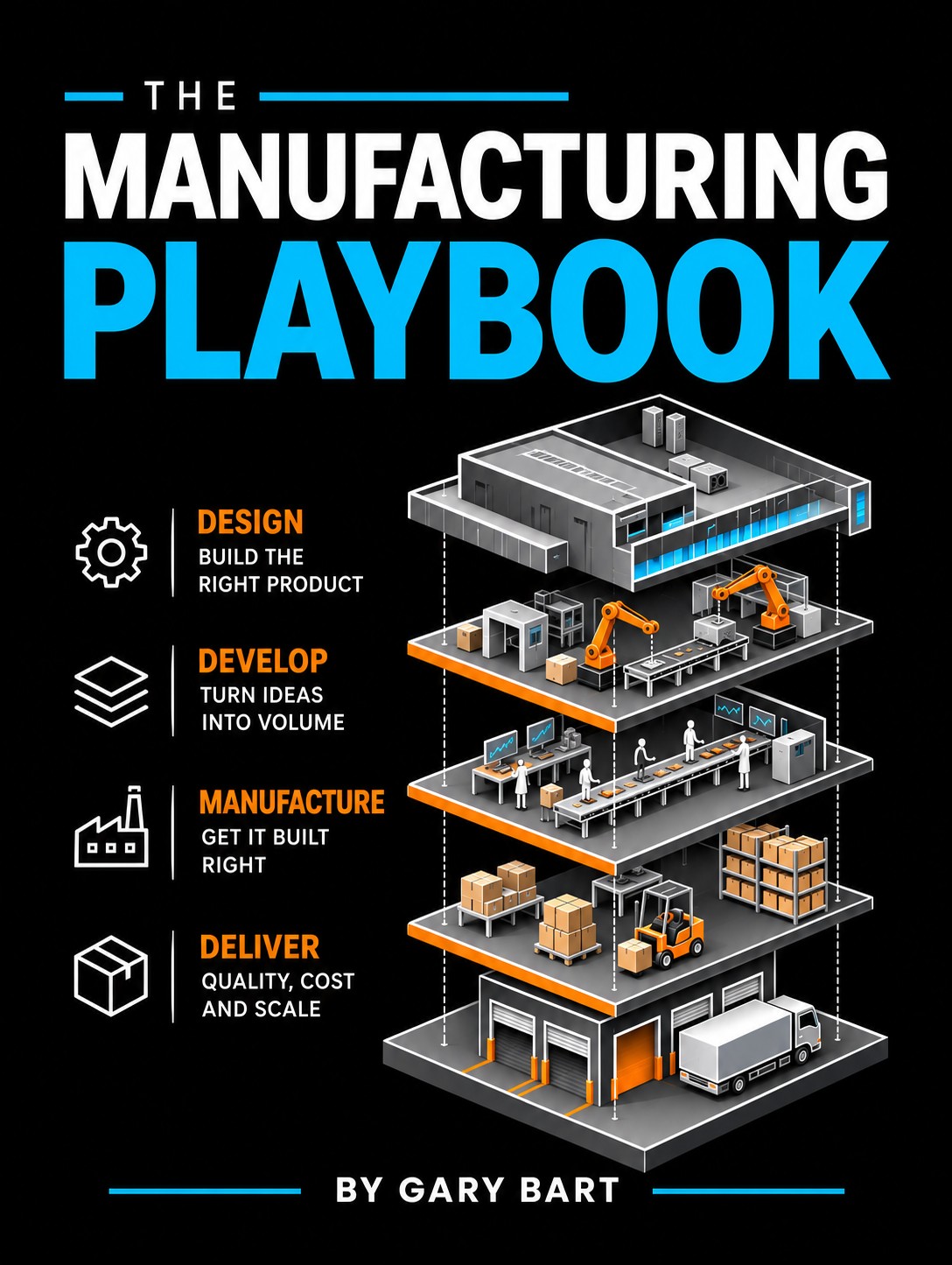
Cover of The Manufacturing Playbook by Gary Bart
50
chapters in 12 Parts
5
country chapters: US, China, Taiwan, Vietnam, India
8
appendices, including a glossary and Incoterms tables
33
working tools in the optional toolkit
6
Claude skills included with the toolkit

Three ways to read it

The digital book comes in all three. Same text, same chapter and tool numbers.

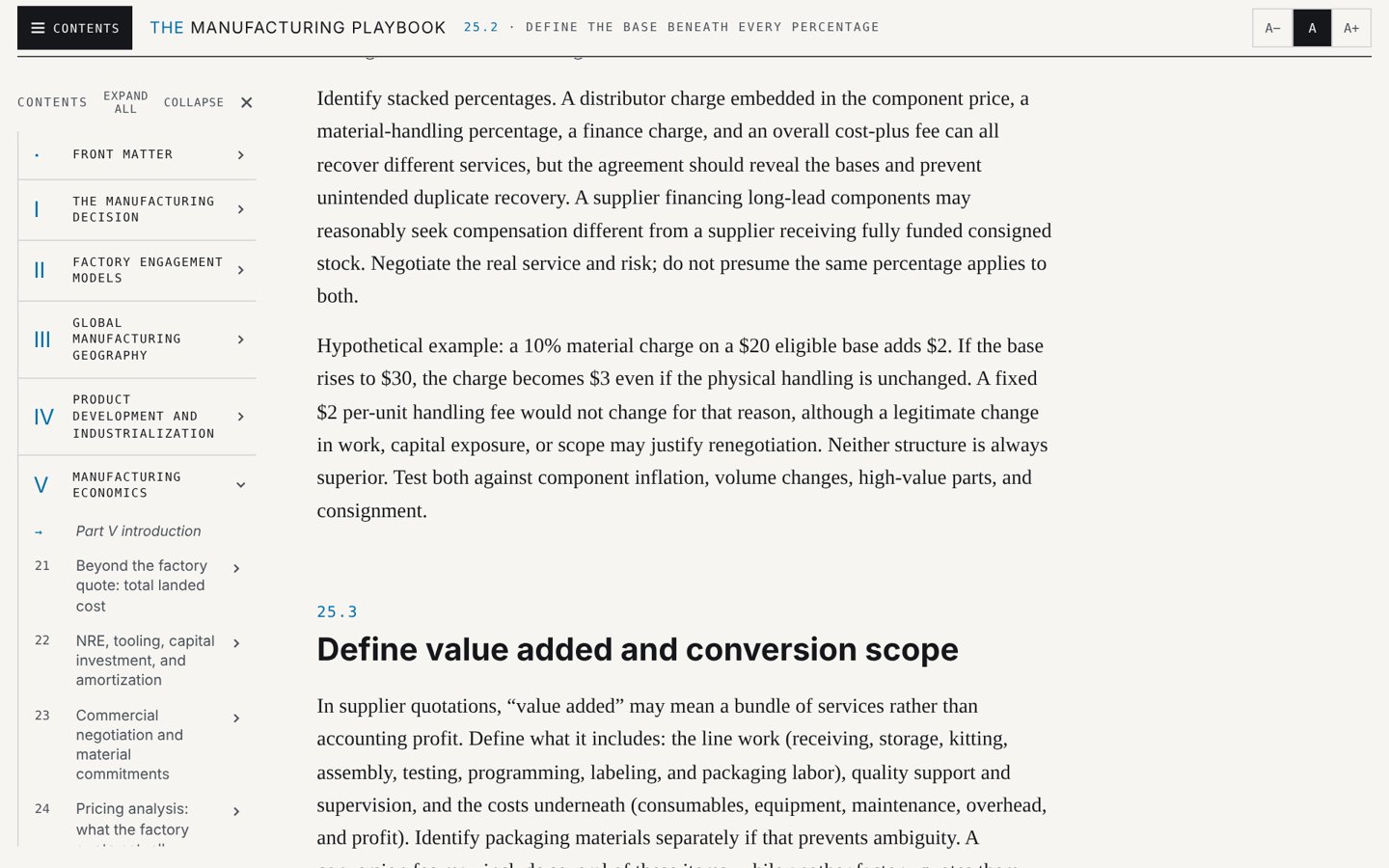
The browser reader showing Chapter 25 with the contents menu open
HTML · BROWSER READER

Read it in any browser

A contents menu organized by Part and chapter, adjustable text size, and cross-references that link to the section they cite. Works on a laptop, tablet, or phone, from your library. Ask the Playbook, the AI assistant, is built in on every chapter: ask a question and it answers from the book.

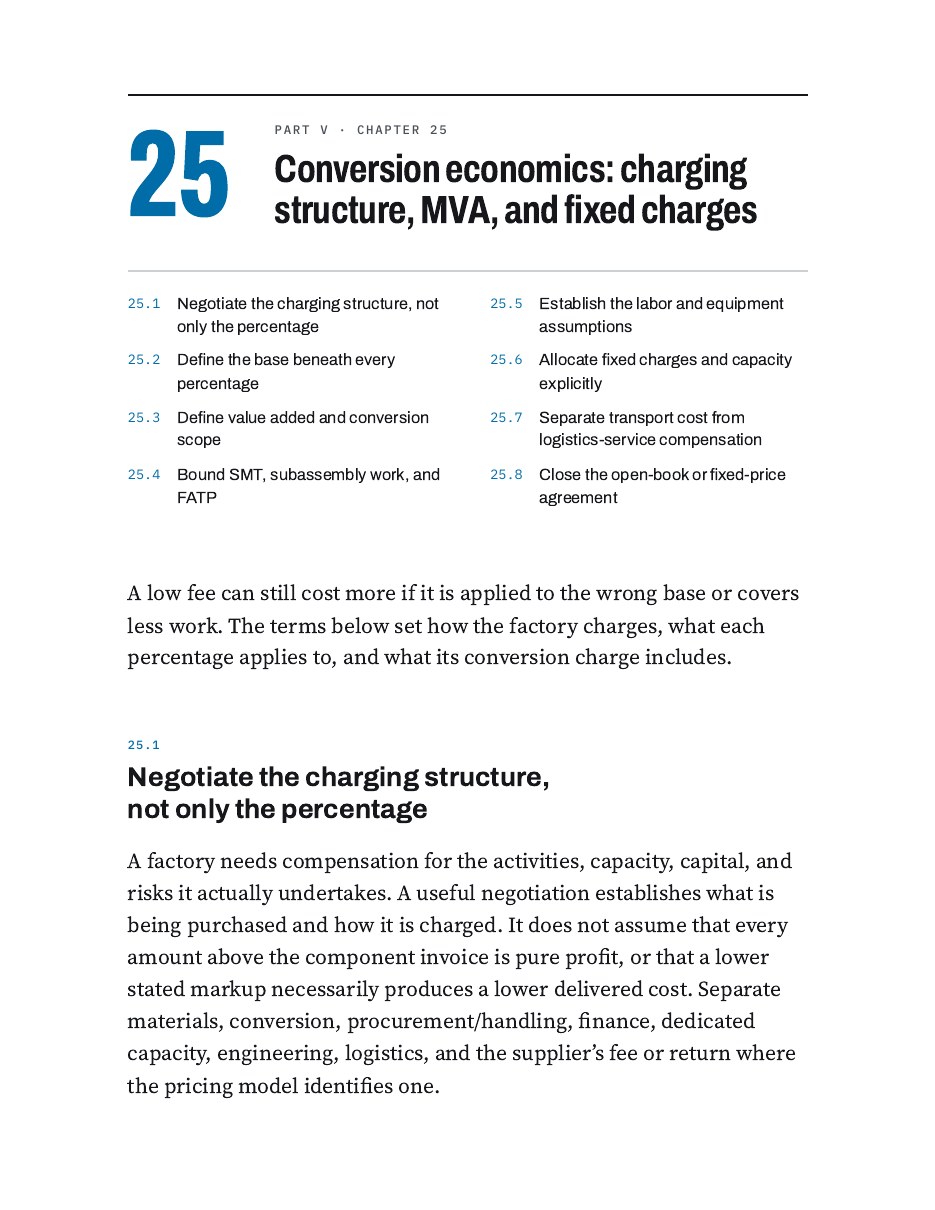
Chapter 25 opening page in the US Letter PDF
PDF · US LETTER

Print it, mark it up

Portrait pages for printing or annotating. Linked contents, bookmarks for every Part and chapter, and each chapter starts on a new page. Personalized to you.

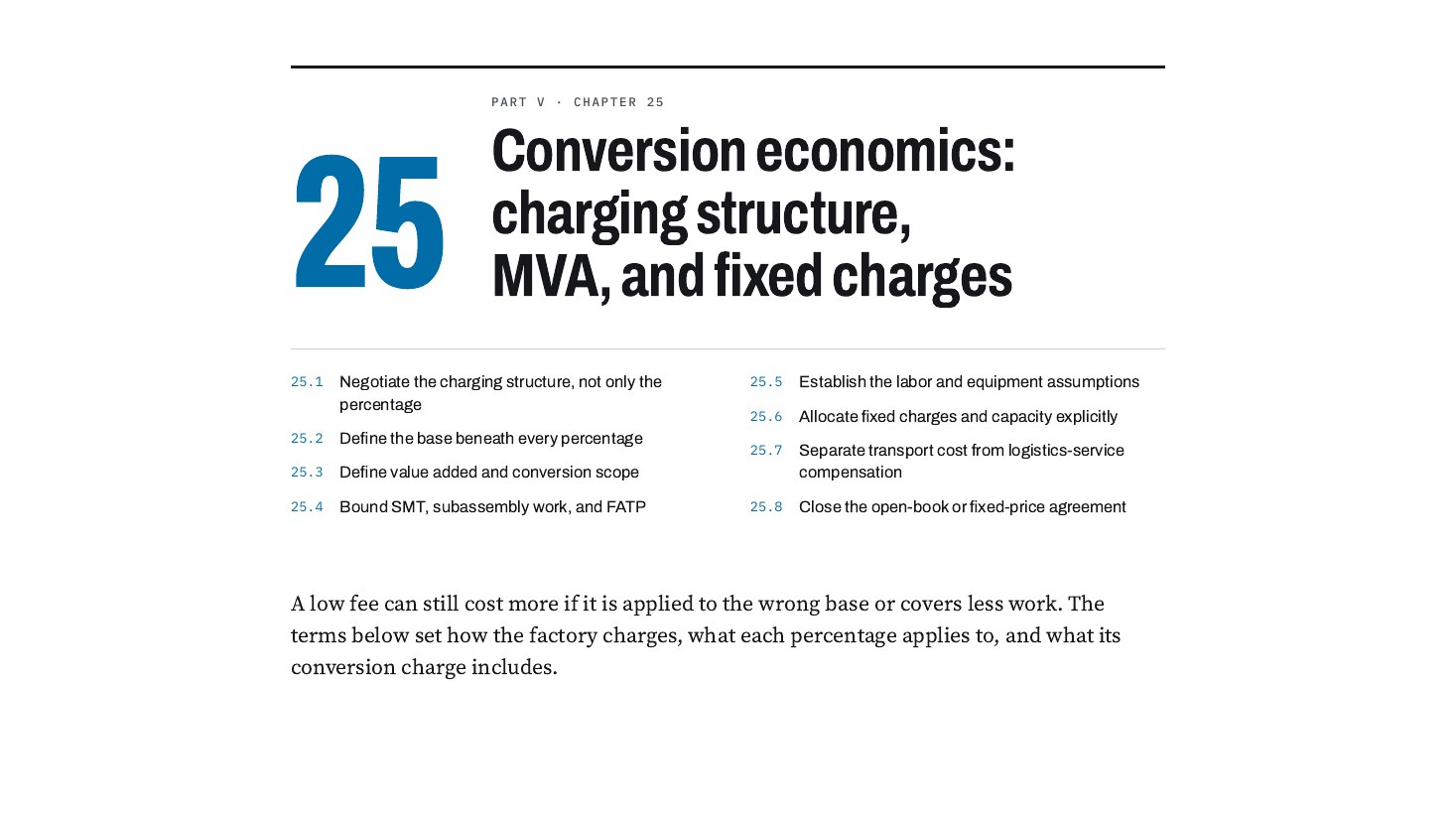
Chapter 25 opening page in the widescreen PDF
PDF · WIDESCREEN 16:9

Made for a laptop screen

Landscape pages sized to fill a computer screen, so you read a full page without zooming or scrolling. Same linked contents and bookmarks. Personalized to you.

Get it before you send your first RFQ.
See pricing Book + toolkit

Who it’s for

Working with a factory for the first time

“If you run product or operations at a hardware brand and are about to work with a factory for the first time, read Parts I and II in order, then the chapters below, then the rest as you reach each stage.”

You’ve done this before

“If you have done this before, use the book as a reference: start with control, agreements, and IP (Chapters 33–38), then go to the decision in front of you.”

A team of two to five

“A team of two to five people can’t run all of it, and doesn’t need to.” The book says which steps not to skip, and which can be lighter.

Quoted from “Start here.”

Read a sample

Verbatim from the book.

CHAPTER 25 · CONVERSION ECONOMICS

From Chapter 25 — Conversion economics

Many factories quote in two parts: the bill of materials (the parts, chips, plastics, and other components) and manufacturing value add, usually shown as MVA. MVA is what the factory charges to turn those materials into a finished product: direct labor, factory overhead (utilities, facilities, equipment maintenance, and depreciation), process steps such as SMT, PCBA test, and FATP, and the factory’s margin.

Keeping the two apart shows what you pay for parts, whose prices move with the market, separately from what you pay for the factory’s work. It also puts the factory’s efficiency on the table. If MVA is high, you can push on cycle time, line balance, or manual labor instead of arguing over the total.

I required every factory to list each of the MVA items separately in our quote format (Chapter 29). Some factories wanted to give us a single MVA line instead, which hid their real costs and their profit in one number. A single line can’t be compared across factories or negotiated item by item.

Do not equate the value-added charge with net income. It may fund wages, support staff, facilities, equipment, losses, and other operating costs. Likewise, identify whether an explicit profit/fee is already inside the conversion rate or added after cost.

That’s one section. There are 49 more chapters.
See pricing Book + toolkit

What’s inside

All 50 chapters, in the order you meet the decisions.

PART I · CH. 1–4

The manufacturing decision

  1. 1The product brand’s role in manufacturing
  2. 2The five decisions that shape manufacturing strategy
  3. 3Define the product before choosing the factory
  4. 4The manufacturing strategy decision framework
PART II · CH. 5–9

Factory engagement models

  1. 5Contract manufacturing (CM)
  2. 6Original design manufacturing (ODM)
  3. 7Joint design manufacturing (JDM)
  4. 8Turnkey, consignment, and hybrid manufacturing models
  5. 9Choosing the right engagement model
PART III · CH. 10–15

Global manufacturing geography

  1. 10Manufacturing in the United States
  2. 11Manufacturing in China
  3. 12Manufacturing through Taiwan-based partners
  4. 13Manufacturing in Vietnam
  5. 14Manufacturing in India
  6. 15Selecting and approving the manufacturing location
PART IV · CH. 16–20

Product development and industrialization

  1. 16Product specifications and engineering deliverables
  2. 17When are you ready to engage a contract manufacturer?
  3. 18Prototypes, EVT, DVT, PVT, and manufacturing release
  4. 19Design for manufacturing and assembly (DFM/DFA)
  5. 20Tooling, fixtures, and production equipment
PART V · CH. 21–26

Manufacturing economics

  1. 21Beyond the factory quote: total landed cost
  2. 22NRE, tooling, capital investment, and amortization
  3. 23Commercial negotiation and material commitments
  4. 24Pricing analysis: what the factory quote actually contains
  5. 25Conversion economics: charging structure, MVA, and fixed charges
  6. 26Payment, credit, and commercial closeout
PART VI · CH. 27–32

Selecting and qualifying manufacturers

  1. 27Finding and shortlisting manufacturers
  2. 28Manufacturing capabilities: electronics and non-electronic products
  3. 29RFIs, RFQs, and RFPs
  4. 30Factory audits and supplier qualification
  5. 31Working across cultures: communication, negotiation, and escalation
  6. 32Staffing in Asia, business travel, and the relationships behind manufacturing
PART VII · CH. 33–38

Contracts, intellectual property, and control

  1. 33Who really controls your product?
  2. 34Manufacturing agreements: structure and commercial terms
  3. 35Quality remedies and defect allowances
  4. 36Brand and factory warranties
  5. 37Continuity, exit, and cross-border disputes
  6. 38Intellectual property, licensing, and tooling rights
PART VIII · CH. 39–44

Production, quality, and operations

  1. 39Production launch and ramp management
  2. 40Quality systems, inspection, and statistical sampling
  3. 41In-line, end-of-line, and independent OTB testing
  4. 42Firmware, OTA updates, and connected-product lifecycle management
  5. 43Regulatory compliance, certification, and cybersecurity
  6. 44Sustaining the product and the factory after launch
PART IX · CH. 45–46

International trade and supply chains

  1. 45Importing products into the United States
  2. 46Supply-chain resilience and risk management
PART X · CH. 47–48

Scaling, relocating, and exiting

  1. 47Scaling manufacturing and managing multiple factories
  2. 48Moving production or exiting a manufacturer
PART XI · CH. 49–50

Applied decision-making

  1. 49Worked decision cases
  2. 50Making the final manufacturing decision
PART XII · APP. A–H

Appendices and professional toolkit

  1. AThe toolkit
  2. BWhich tools to use at each stage
  3. CSource and verification register
  4. DUsing the toolkit
  5. EReader’s glossary
  6. FSuggested development sequence
  7. GFigures, tables, and art
  8. HIncoterms 2020 summary tables
All 50 chapters in three formats.
See pricing Book + toolkit

The companion toolkit (optional)

“For example, you can use the requirements templates to define what the product needs to do, send the same RFQ package to each factory, and compare the bids in a single workbook. There are also tools for auditing factories, calculating landed cost and cash requirements, reviewing manufacturing agreements, and managing quality issues and factory transfers. The working templates come with a completed teaching example and a blank copy for your own project.”

The book refers to each tool by number, so you can find the one that goes with the decision you’re making.

33 tools · Excel, Word, and PDF
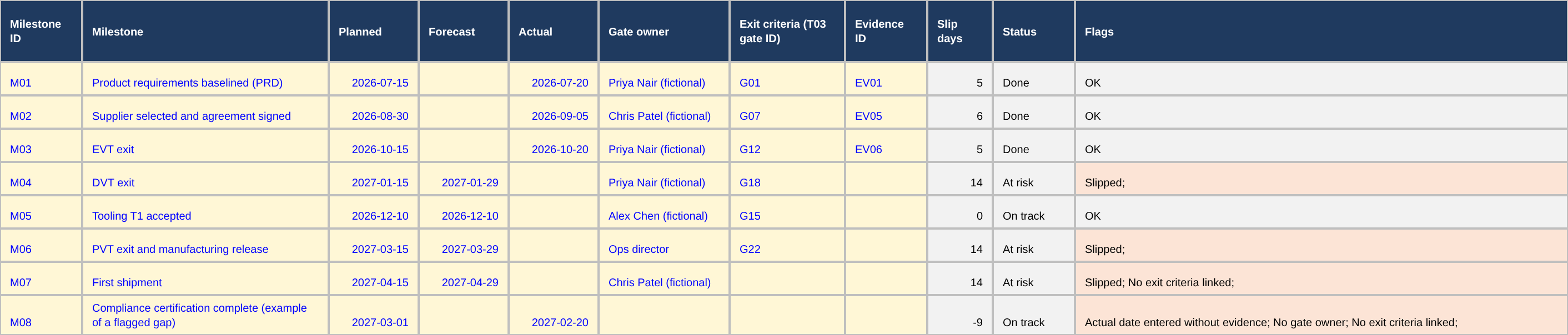
T33 Program plan and tracker, Milestones sheet with teaching data
T33 Program plan and tracker, teaching copy (fictional names). Forecast slips are calculated, and a milestone with an actual date but no evidence is flagged instead of marked done.
T32 DFM, DFA, and design-for-cost review, Change Proposals sheet with teaching data
T32 DFM, DFA, and design-for-cost review, teaching copy. Each proposed change carries its net value and priority. The toolmaker’s draft change is rejected with the reason recorded; a late connector swap that never recovers its cost is flagged.

All 33 tools

Start with files you can send to your factory.
See pricing Book + toolkit

PRODUCT UPDATE

Your Manufacturing Toolkit. Now with Its Own AI Assistant.

Expert guidance when you need it. Powerful tools when you're ready to act.

The Manufacturing Playbook Templates Toolkit now includes an always-available AI Manufacturing Assistant and six specialized AI Skills for Claude.

Manufacturing decisions don't always happen during business hours. Questions arise during factory negotiations, quotation reviews, engineering meetings, and production crises.

Now you have more than a collection of templates. You have an AI-powered manufacturing resource designed to help you find answers, evaluate options, and put the Playbook's methods to work.

YOUR 24/7 AI MANUFACTURING ASSISTANT

Ask the Playbook. Get answers. Keep moving.

Every Toolkit purchaser receives access to a dedicated AI Manufacturing Assistant, available around the clock.

Ask questions in plain English and receive guidance grounded in The Manufacturing Playbook's methods, processes, and practical manufacturing experience.

  • Get answers anytime. Explore manufacturing processes, supplier relationships, tooling, quality, production, and cost management.
  • Navigate complex decisions. Understand trade-offs, evaluate options, and identify potential risks.
  • Find the right tools. Locate relevant chapters, templates, checklists, and workflows.
  • Put knowledge into practice. Apply the Playbook's methods to real-world manufacturing situations.
  • Keep working. Get guidance whenever questions arise, regardless of time zone or business hours.

It's like having The Manufacturing Playbook available for a conversation, whenever you need it.

SIX SPECIALIZED AI MANUFACTURING SKILLS

Go beyond asking questions. Put AI to work.

Your Toolkit also includes six purpose-built AI Skills for Claude, designed to help complete specific manufacturing tasks.

01 · RFQ & BOM Preparation

Organize product requirements, prepare bills of materials, and build more complete quotation packages before approaching manufacturers.

02 · RFQ Comparison Analyst

Analyze competing factory quotations, uncover missing costs and inconsistent assumptions, and compare supplier proposals on a consistent basis.

03 · Landed Cost Analysis

Look beyond the factory quotation to evaluate freight, duties, logistics, and other costs that determine your product's actual landed cost.

04 · Factory Audit Report

Structure factory evaluations, document findings, identify operational risks, and prepare actionable audit reports.

05 · Factory Engagement & Negotiation

Prepare for supplier discussions, evaluate commercial terms, clarify responsibilities, and strengthen your negotiating position.

06 · EVT Gate Review

Assess engineering validation readiness, organize unresolved issues, evaluate risks, and support disciplined decisions about advancing development.

These aren't generic AI prompts. They're specialized manufacturing workflows built around the practical methods of The Manufacturing Playbook.

SIX SKILLS TODAY. MORE ON THE WAY.

Your Toolkit keeps getting better.

We're continuing to develop new AI Manufacturing Skills to address additional challenges across product development, sourcing, manufacturing, quality, and production.

As new skills become available, they'll appear in your Playbook library as part of the toolkit download, free of charge.

There's nothing additional to purchase. Your collection of AI-powered manufacturing tools will continue to expand as new skills are released within your purchased edition.

ONE TOOLKIT. THREE WAYS TO WORK.

READ IT. Learn from The Manufacturing Playbook's real-world manufacturing experience.

USE IT. Apply its editable spreadsheets, templates, checklists, and working documents to your own products and projects.

ASK IT. Consult your dedicated AI Manufacturing Assistant and use specialized AI Skills to help tackle the work.

ALL INCLUDED WITH YOUR TOOLKIT PURCHASE

Your Templates Toolkit includes:

  • Editable manufacturing templates, spreadsheets, checklists, and working documents.
  • One download of 119 files: all 33 tools as clean templates and filled-in teaching copies, two Read Me First guides, and five practice files for the skills.
  • Access to your dedicated 24/7 AI Manufacturing Assistant.
  • Six specialized AI Manufacturing Skills for Claude.
  • New AI Skills added to your library download at no additional charge as they're released within your purchased edition.
  • Lifetime access to Toolkit revisions within your purchased edition.

The knowledge. The tools. The AI assistance. All in one toolkit.

Buy once. Keep learning. Keep building.

AI-generated guidance and analyses require professional review and do not replace engineering validation, legal advice, or supplier verification. The skills need a Claude account with code execution turned on; quote comparison also uses the free Playbook connector. Claude is a product of Anthropic; the Playbook skills are not made or endorsed by Anthropic. AI services require an internet connection and are subject to service availability.

Gary Bart

About Gary Bart

Gary Bart has spent more than 40 years starting, building, and running businesses, including 25 years developing products and bringing them to market. He founded XtremeMac the year Apple introduced the iPod, and went on to build products at Stem Innovation, Zendo, and Alarm.com, where he was Vice President of the Design Studio.

The book draws on that work: the quotes, factory audits, negotiations, validation builds, customs holds, and launches he ran himself. Where he uses his own companies as examples, he names them.

garybart.com
Twenty-five years of factory work, in one book.
See pricing Book + toolkit

Editions

Prices are in USD.

Digital book

$29

  • Browser reader
  • Personalized PDF, US Letter
  • Personalized PDF, widescreen for on-screen reading
  • Ask the Playbook AI assistant, built into the reader
BEST VALUE

Book + toolkit

$199

  • Everything in the digital book
  • All 33 tools in Excel, Word, and PDF
  • A teaching example and a blank copy of each working template
  • Six Claude skills, with a setup guide

Toolkit only

$179

  • All 33 tools in Excel, Word, and PDF
  • Completed examples and blank templates
  • Six Claude skills, with a setup guide
Paperback edition coming.

Questions

Do I need the toolkit?

No. “The book includes the frameworks, checklists, and tables you need to do the work. The toolkit gives you files you can start using with your team and your factory.”

What formats do I get?

The digital book is a browser reader plus two PDFs personalized to you: US Letter for print, and widescreen for reading on a laptop. The toolkit is Excel workbooks, Word templates, and reference PDFs.

What kinds of products does it cover?

Physical products made by contract, ODM, and JDM factories, electronic and non-electronic, with chapters on firmware, over-the-air updates, and connected-product compliance.

How current is the trade and regulatory material?

Regulatory, tariff, and legal information in the book is current as of November 15, 2026. The importing chapter is written for products brought into the United States.

Do I get updates?

Your purchase includes lifetime access to revisions within that edition. Major new editions are sold separately.

Can my team share one copy?

Team licensing terms are pending.

What if it isn’t what I expected?

Refund terms will be available when checkout opens.

This charge will show on your statement as MyLifeSaved, LLC